Xlaserlab Review: Exploring Portable Laser Welding, Cleaning, Cutting, and Engraving Technology
Xlaserlab Review: Exploring Portable Laser Welding, Cleaning, Cutting, and Engraving Technology
Laser technology has moved far beyond large industrial facilities. Modern laser tools are becoming more compact, versatile, and accessible, giving makers, fabricators, workshops, restoration specialists, and small businesses new ways to approach metalworking and surface treatment.
Xlaserlab is a brand operating in this space with a product lineup centered around laser welding, laser cleaning, laser cutting, and laser engraving. Rather than concentrating on only one application, the company has developed several systems designed to combine multiple capabilities into relatively portable machines.
Its current lineup includes the X1 Pro laser welder, X1 laser welder, Q1 laser cleaning and engraving system, and E3 UV laser engraver. The brand also offers dedicated accessories, protective equipment, wire-feeding components, lenses, nozzles, and other supporting equipment.
But laser equipment is not something that should be selected based on specifications alone. The right machine depends on the materials being processed, the type of work being performed, required precision, workspace, operator experience, safety requirements, and intended frequency of use.
This Xlaserlab review takes a closer look at the brand, its major machines, the technology behind its product range, practical applications, portability, safety considerations, support resources, and the things buyers should understand before choosing a laser system.
What Is Xlaserlab?
Xlaserlab is a laser technology company focused on equipment for fabrication, cleaning, cutting, welding, and engraving.
The brand's current product ecosystem is built around several different types of laser equipment rather than a single machine category.
Its lineup currently includes:
Laser welding systems
Laser cleaning equipment
Laser engraving machines
Laser cutting capabilities
Protective helmets and eyewear
Wire feeders
Welding nozzles
Protective lenses
Focusing and collimating components
Rotary and conveyor accessories
Other machine-specific accessories
This makes Xlaserlab particularly interesting for users who want to explore multiple laser-based workflows rather than purchasing a tool dedicated to only one task.
A Different Approach to Laser Equipment
Traditional industrial laser equipment can require considerable floor space, dedicated infrastructure, specialized workflows, and significant technical knowledge.
Xlaserlab's product philosophy is different.
The company places considerable emphasis on portability and multifunctionality, especially with its X-series machines.
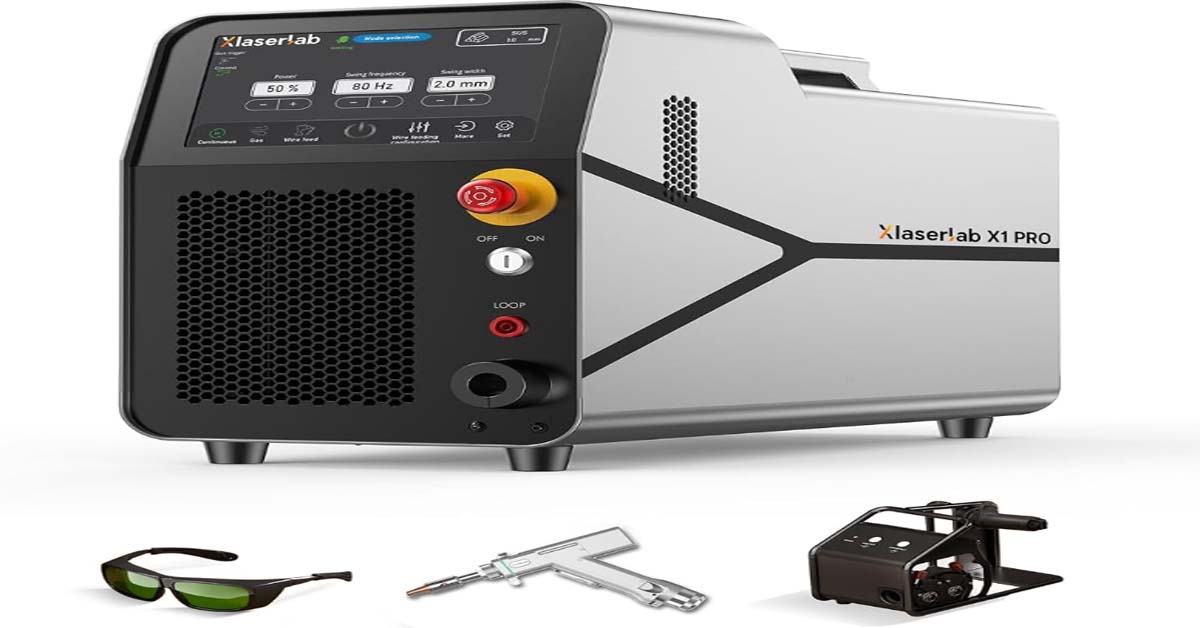
The X1 Pro, for example, is presented as a 3-in-1 system capable of laser welding, cleaning, and cutting.
The idea behind this approach is straightforward: instead of requiring separate machines for different workshop tasks, a single system can potentially cover multiple applications.
That can be particularly appealing to smaller workshops or mobile operators where available space is limited.
Xlaserlab X1 Pro
The X1 Pro is one of the most notable machines in the current Xlaserlab lineup.
It combines three functions:
Laser welding
Laser cleaning
Laser cutting
Xlaserlab describes the X1 Pro as a consumer-grade laser welding system while also positioning it for professional and workshop applications.
The machine uses a 700W-class fiber laser configuration and is designed to work with materials such as stainless steel, aluminum, and carbon steel.
The company states that its welding and cutting capabilities can reach materials up to 3mm thick, depending on the application and conditions.
Why the 3-in-1 Design Matters
Having multiple functions in one machine can make sense for workshops that regularly move between different tasks.
A fabricator may need to weld one component, clean an existing metal surface, and then perform cutting work.
With separate equipment, each operation can require a different machine and workspace.
A multifunctional system can potentially simplify that workflow.
However, buyers should still evaluate each function independently. A machine being capable of several processes does not necessarily mean it will replace every specialized piece of industrial equipment.
Laser Welding With Xlaserlab
Laser welding is one of Xlaserlab's primary areas of focus.
Compared with conventional welding methods, laser welding uses a concentrated beam of light to create the weld.
The technology can offer a highly focused working area, which is one reason laser welding is attractive for applications where control and appearance matter.
Xlaserlab highlights applications involving stainless steel, aluminum, and carbon steel.
Potential use cases include:
Metal fabrication
Automotive repair
Furniture-frame work
Restoration
Custom metal projects
Small manufacturing jobs
Artistic metalworking
The actual results will depend on material type, thickness, settings, operator technique, joint preparation, and other variables.
Xlaserlab X1
The standard X1 is positioned as a more focused laser welding solution.
Xlaserlab describes it as a laser pen welder intended to make laser welding more approachable for beginners.
The European product information lists the X1 with a 460W fiber laser and capabilities for welding and cutting materials up to 2mm thick.
The X1 is particularly interesting because of its pen-style concept.
Instead of presenting laser welding purely as a large industrial-machine workflow, the design aims to make the welding tool itself more compact and easier to handle.
This could be useful for detailed work where operator control and maneuverability are important.
Portable Laser Welding
Portability is a recurring theme across Xlaserlab's products.
The company's machines are designed to be significantly more mobile than many traditional industrial laser systems.
That can matter for:
Mobile repair work
On-site fabrication
Small workshops
Garage workshops
Restoration projects
Artists and makers
Businesses with limited floor space
Portability does not mean the equipment should be treated casually, though.
Laser systems still require appropriate workspace preparation, ventilation considerations, protective equipment, electrical planning, and safe operating procedures.
Laser Cleaning With Xlaserlab
Laser cleaning is another major category within the brand's lineup.
Instead of using abrasive materials or chemical cleaning methods, laser cleaning uses controlled laser energy to remove unwanted surface material.
Depending on the machine and application, this can be used for removing:
Rust
Paint
Oxidation
Surface contaminants
Coatings
Residue
One of Xlaserlab's dedicated cleaning machines is the Q1.
Xlaserlab Q1
The Q1 is positioned as a 2-in-1 laser cleaner and engraver.
This makes it different from the X1 Pro, which combines welding, cleaning, and cutting.
The Q1 is designed more specifically around surface treatment and engraving applications.
Xlaserlab highlights MOPA pulsed laser technology for the Q1, describing it as suitable for controlled layer-by-layer cleaning while aiming to minimize unnecessary impact on the underlying substrate.
This kind of system can be interesting for restoration and surface-preparation work.
Where Laser Cleaning Can Be Useful
Laser cleaning can have applications in many workshop environments.
Examples include:
Removing rust from metal components
Preparing surfaces before welding
Cleaning old machinery
Restoration projects
Removing paint or coatings
Preparing parts for finishing
Cleaning certain industrial components
The exact suitability depends heavily on the material and contaminant being removed.
Users should test appropriate settings on suitable samples before applying a laser cleaning process to valuable or sensitive components.
Laser Engraving With Xlaserlab
Engraving represents another side of the Xlaserlab product range.
The brand's E3 is designed specifically around UV laser engraving.
Unlike a traditional fiber laser engraving approach, UV laser systems are often selected for applications where reduced thermal impact and fine marking are important considerations.
Xlaserlab describes the E3 as a high-power UV laser engraver designed for marking a wide range of materials.
Xlaserlab E3 UV Laser Engraver
The E3 is currently listed as a 10W UV laser engraving machine.
The brand highlights a cold-light-source approach for engraving materials such as glass and crystal and emphasizes precision-oriented marking.
The company also promotes micron-level precision and a small heat-affected zone as part of its technology positioning.
This makes the E3 particularly interesting for users who need detailed marking rather than primarily heavy metal fabrication.
Potential applications can include:
Product identification
Decorative engraving
Glass marking
Crystal marking
Detailed customization
Small-part marking
Creative projects
As with any engraving system, actual results depend on the material, surface finish, laser settings, and design.
Why UV Laser Engraving Is Interesting
Different materials react differently to laser energy.
A UV laser can be attractive when working with materials that may not respond ideally to other laser wavelengths.
The shorter wavelength associated with UV systems can provide a different interaction with certain surfaces, which is one reason UV engraving has become relevant for detailed marking applications.
For businesses involved in product customization, identification, or fine decorative work, this can open up applications that are not necessarily the focus of a conventional metalworking laser.
Portability as a Major Theme
Xlaserlab clearly emphasizes portability across its product range.
Its product materials describe lightweight designs and mobile workflows, with some systems presented in the 13kg–17kg range.
Portability can be a significant advantage for small workshops.
A machine that can be moved between work areas can make better use of limited space.
It can also be useful for contractors or fabricators who need to perform work at different locations.
However, portability should always be evaluated together with the complete setup.
The machine itself may be relatively mobile while accessories, protective equipment, ventilation, power requirements, and workpieces still require adequate workspace planning.
Xlaserlab's Focus on Multifunctionality
Perhaps the most interesting aspect of the brand is its attempt to combine multiple processes into fewer machines.
The X1 Pro is a strong example.
Instead of purchasing separate equipment for:
-
Welding
-
Cleaning
-
Cutting
the X1 Pro combines those capabilities into one platform.
This approach can be particularly appealing to small businesses.
A small fabrication shop may not have unlimited floor space. A mobile operator may not want to transport several machines.
Multifunctionality can therefore be a practical consideration rather than simply a marketing feature.
Accessories and Supporting Equipment
Laser machines are only one part of a complete workflow.
Xlaserlab also offers a selection of accessories designed around its equipment.
These include:
Laser protection helmets
Auto-darkening filter helmets
PAPR respirator helmets
Laser protection goggles
Protective screens
Wire feeders
Welding wire
Copper nozzles
Welding nozzles
Protective lenses
Focusing lenses
Collimating lenses
Rotary attachments
Conveyor accessories
The availability of machine-specific accessories can be useful because compatible components are important for maintaining the intended operation of specialized equipment.
Laser Safety Is Essential
Laser equipment requires a much more serious safety approach than ordinary workshop tools.
A laser can cause serious eye and skin injuries, and welding and cutting processes can introduce additional hazards such as fumes, heat, sparks, and reflected radiation.
Xlaserlab offers protective helmets, eyewear, and other safety equipment as part of its product ecosystem.
The company's product materials also describe safety features such as multi-lock protection, emergency stops, and Class 1 enclosures on applicable systems.
Still, machine safety features should not be treated as a substitute for proper training and safe operating procedures.
Users should carefully follow the manufacturer's documentation and relevant local workplacesafety requirements.
Learning Curve and Operator Experience
Laser equipment can look straightforward from the outside, but achieving consistent results requires understanding the relationship between:
Laser power
Speed
Frequency
Material
Thickness
Focus
Gas flow
Feed rate
Beam characteristics
Surface condition
Xlaserlab provides an Academy, product manuals, tutorials, FAQs, and product-specific support resources to help users learn their machines.
This support structure is important because even a technologically advanced machine still requires an operator who understands how to use it appropriately.
Xlaserlab Support Resources
Support is another notable part of the brand's ecosystem.
The company's support center provides dedicated resources for its major product categories.
Users can find support information for:
X1 Pro
X1
E3
Q1
The support area also provides learning materials, manuals, tutorials, shipping information, warranty resources, and return-related information.
For specialized equipment, having documentation available after purchase can be almost as important as the hardware itself.
Who Might Consider Xlaserlab?
Xlaserlab's products are aimed at a fairly specific audience.
Metal Fabricators
The X1 and X1 Pro can be relevant to fabricators who need portable welding and cutting capabilities.
Restoration Specialists
Laser cleaning can be useful for restoration-related surface preparation and removing unwanted coatings or oxidation.
Makers and DIY Enthusiasts
Users who enjoy advanced metalworking projects may find multifunctional laser systems appealing.
Small Businesses
A compact multifunctional machine can be attractive to businesses that need several capabilities without filling an entire workshop with specialized equipment.
Customization Businesses
The E3 UV engraver may be particularly interesting for businesses working with detailed product marking and customization.
Who Should Think Carefully Before Buying?
Laser equipment is a substantial investment and is not necessarily appropriate for casual users.
Someone who only needs to engrave small decorative items occasionally may not need a professional-grade UV laser system.
Likewise, a person who only performs simple welding jobs may find a traditional welding setup more appropriate depending on their specific requirements.
Buyers should first identify the exact tasks they need to perform and then determine whether a laser system genuinely improves their workflow.
Things to Consider Before Choosing Xlaserlab
1. Know Your Materials
Different materials respond differently to laser energy.
Determine exactly what you plan to weld, cut, clean, or engrave before selecting a machine.
2. Understand Thickness Requirements
A machine's advertised maximum thickness should not automatically be interpreted as a universal capability.
Material type, joint design, settings, and operating conditions can affect results.
3. Plan Your Workspace
Even portable laser equipment needs an appropriate operating environment.
Consider ventilation, power, workpiece handling, safety barriers, and available space.
4. Budget for Accessories
Protective equipment, consumables, lenses, nozzles, wire feeders, and other accessories can become part of the overall ownership cost.
5. Consider Training
If you have never used laser equipment before, plan time for learning the machine and understanding its safety procedures.
6. Compare Single-Purpose and Multifunction Machines
A multifunctional system is not automatically the best choice.
If you perform one specialized process continuously, a dedicated machine may sometimes make more sense.
Xlaserlab for Small Workshops
Small workshops can face a difficult equipment problem.
They may need several capabilities but have limited space and budget.
A multifunctional system can potentially help solve part of that problem.
The X1 Pro is particularly interesting in this context because welding, cleaning, and cutting are integrated into one system.
That could allow a workshop to handle a broader variety of jobs without dedicating separate floor space to three different machines.
However, prospective buyers should compare the machine's specifications with their actual workload rather than choosing based on multifunctionality alone.
Xlaserlab for Mobile Work
Portability also makes Xlaserlab interesting for mobile applications.
On-site repair and fabrication can sometimes be difficult when equipment is designed primarily for permanent workshop installation.
A portable laser welder can provide more flexibility when the workpiece cannot easily be transported.
This could be relevant to:
Equipment repair
Automotive work
Metal restoration
On-site fabrication
Agricultural machinery repair
Custom installations
The exact suitability depends on the job, power availability, workspace conditions, and safety requirements.
Maintenance and Consumables
Like other specialized workshop equipment, laser machines require ongoing maintenance.
Xlaserlab's support materials specifically discuss components such as protective lenses and copper nozzles.
The company recommends regularly checking protective lenses for debris and replacing worn components when necessary.
This is an important part of ownership.
A laser machine should not be viewed as a completely maintenance-free tool. Keeping optical components clean and replacing consumables when required can be essential to consistent operation.
The Importance of Protective Equipment
Protective equipment deserves its own consideration.
Xlaserlab offers several forms of laser protection, including:
Laser protection goggles
Auto-darkening helmets
PAPR respirator helmets
Protective screens
The correct protection depends on the specific laser system, wavelength, process, and work environment.
Users should rely on the manufacturer's specifications and applicable safety standards rather than choosing protective equipment based solely on appearance or price.
What Makes Xlaserlab Stand Out?
Xlaserlab's strongest differentiator is its focus on bringing multiple laser processes into portable systems.
The brand combines:
Welding
Cutting
Cleaning
Engraving
across its current product lineup.
The X1 Pro focuses on welding, cleaning, and cutting.
The Q1 combines cleaning and engraving.
The E3 focuses on UV engraving.
The X1 provides a more compact laser welding approach.
This gives the brand a broader identity than a company that sells only one type of laser machine.
Overall Impression
Xlaserlab is an interesting brand for users who are ready to explore more advanced fabrication and surface-processing technology.
Its lineup is clearly aimed beyond ordinary household tools, with products intended for makers, fabricators, restoration work, engraving, and small-business applications.
The X1 Pro is particularly notable for its multifunctional design, while the Q1 and E3 allow users to explore more specialized cleaning and engraving workflows.
The brand also puts noticeable emphasis on portability, support resources, accessories, and safety equipment.
At the same time, these are specialized machines. Buyers should not approach them like ordinary consumer electronics.
Understanding laser safety, material compatibility, workspace requirements, maintenance, and operating procedures is essential.
Final Verdict
Xlaserlab is a compelling option to explore for makers, fabricators, restoration specialists, and small businesses interested in portable laser technology.
Its lineup covers several important applications, from metal welding and cutting to surface cleaning and detailed UV engraving. The multifunctional X1 Pro is particularly appealing for users who want several capabilities from a single machine, while the Q1 and E3 provide more focused solutions for cleaning and engraving.
The biggest advantage of Xlaserlab is its combination of versatility, portability, and specialized laser technology.
However, these machines require thoughtful purchasing decisions. Buyers should understand their materials, intended applications, workspace, safety requirements, maintenance needs, and desired level of precision before choosing a particular model.
For someone looking to expand a workshop beyond conventional tools, Xlaserlab offers an interesting range of equipment to investigate. The best choice will ultimately be the machine that matches the user's actual workflow rather than simply the machine with the largest specification lis